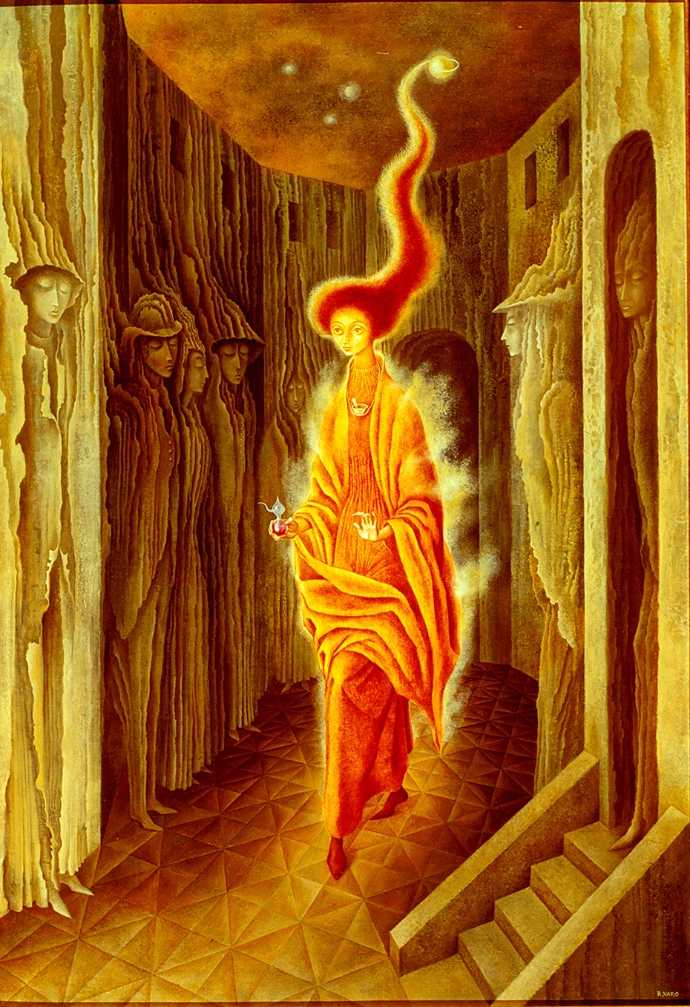
The Call, Remedios Varo
The other day, I came across a quote by Picasso: "The purpose of art is washing the dust of daily life off our souls."
And I immediately thought of some artists who viewed art not just as a refuge or a cathartic exercise, but as a fearless excavation of their inner world ―artists who explored it, battled with it, and ultimately laid it bare without the slightest interest in fitting into the norm.
Remedios Varo, one of the so-called Three Witches of Surrealism, is one of my favourite examples. Few artists navigated the subconscious with such precision and imagination. Her work persistently sought to iluminate the hidden threshold between our tangible reality and the chimerical, dreamlike forces that exist just beyond ordinary perception.
Born in Spain, Varo fled to Mexico in 1941 as an intellectual exile. It was there that she discovered the vital energy that would fuel her finest work. More importantly, Mexico offered her the freedom to fully persue her fascination with the fragile theresholds between human experience and sensory perception; occultism and alchemy; mystery; adventure; the tangible world and those more blurred, elusive realms beyond it; and above all, womanhood ―particularly the liberated woman― and magic as forces of creation. All of it underpinned by a remarkably rigorous scientific and mathematical foundation.
The Call (1961) remains one of her most mesmerising works, not only for the way it weaves vivid, ordinary scenes into dreamlike spaces, but also for its extraordinary use of colour, which renders the central figure almost incandescent. The composition feels hypnotic: meticulously structured through intricate geometric studies and alive with countless elements ―each more fascinating than the last― drawn from an unmistakably magical universe. Together, they open up endless possibilities for interpretation, inviting the viewer to imagine their own narratives, theories and conclusions.
It is impossible not to sense how deeply she obsorbed the mystical and esoteric currents so profoundly woven into Ibero-American art during her years in Mexico. In fact, just imagine a graphic adaptation of The House of the Spirits by Isabel Allende illustrated by Remedios Varo. I'd buy a copy in a heartbeat.
To me, this work speaks to two rather important things. First, the importance of finding a space ―both physical and emotional― in which you feel free to expand without restraint. And second, the peculiar joy and comfort that comes from surrendering to the strange, unruly things unfolding in your own mind.
Personally, I think we are extraordinary lucky to have inherited artistic legacies as magnetic, compelling, and endlessly fascinating as this one.
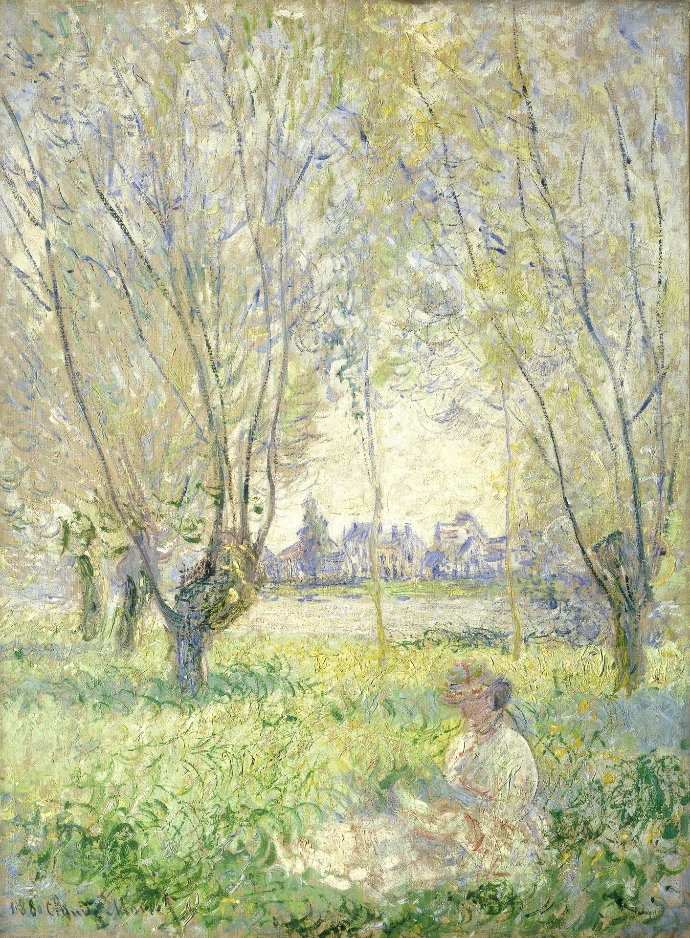
Woman Seated under the Willows, Claude Monet
Do you know that feeling of a reading block? Or that moment when you are about to create something but have absolutely no idea where to start? Here is one of my go-to fixes: Claude Monet.
This artist is one of the best remedies for letting the mind wander and drift into imagination. In my case, that usually takes place in the realm of storytelling.
Perhaps it's the combination of greens and blues soothing both visual and mental noise. Or the loose, carefree brushstrokes, creating that gentle sway that lulls anyone who steps into the scene. Or perhaps it's simply the blurred forms, leaving just enough space for the mind to fill in the gaps and define the rest on its own terms.
Either way, this French painter has done me the great favour of reminding me of all those solo trips I´ve taken.
I'm not sure whether, back in 1880, Alice Hoschedé ―the sitter and the painter's second wife (I'll leave the gossip to you)―would share my point of view, but I like to imagine her as an explorer of her time. She has already wandered through the city depicted in the background and now, free to follow her own course, she rests in the middle of nature, blending into it, trying to inhabit that new space just as any local might. At least that's what I would do, to be honest.
So, although she stands at the centre of the landscape―and as the tittle implies―I struggle to see her as the true focal point of the artwork. To me, she is actually an element that plays a crucial role in enhancing the real leads: the warmth of the air, the shifting light, the gentle breeze, the quiet magic of suspended time itself.
In any case, thanks Monet for inspiring my next literary adventure.
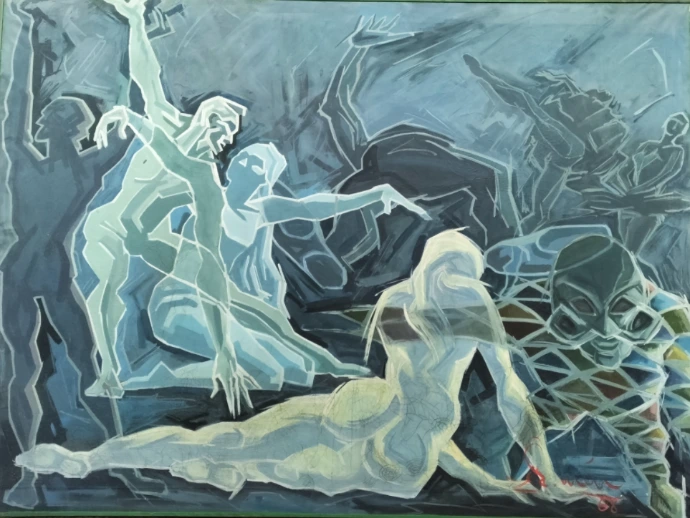
Untitled, Mario Simón
In my ballet salon, there's a painting I can scarcely take my eyes off.
I could say it distracts me so much that my dégagés, rond de jambres, and port de bras are still clumsy and unsteady. But since I once read that "you shouldn't disrespect yourself with excuses", I'll stick to honesty: whatever traces of Andalusian blood run in my family seem to have reached me in a rather short supply.
The fact is that this painting―whose title I do not know―was a gift from Mario Simón himself to his friend Antonio González (theatre director and husband of Pilar Sánchez, an iconic ballerina of Elche), who later displayed the canvas in their dance studio.
The figures, cast in such spectral tones, interweave in a fragmented collage. Their dance techniques and sequences are suspended in a liminal space, as if caught in a fleeting, spectral choreography.
I'm not sure whether Simón painted it specifically for the studio where it now hangs, but it feels perfectly appropriate. To me, it captures the very essence of dancing: the self seems to dissolve, and you are not fully present―instead, for a brief moment, you drift into a private, otherworldly dimension all your own.
Human anatomy, therefore, is understood not merely as a slender, elegant, and beautiful form, but as a vehicle for expression.
In 1968―when the artwork was created―hundreds of artists embraced neo-figurativism. That is to say, they continued to move away from the familiar classical narrative, yet without fully embracing abstraction or surrealism.
In today's class, I couldn't stop thinking that, if I could give it a title, it would be something like "Cartography of Movement". What about you? If you could name this painting, what would you call it?
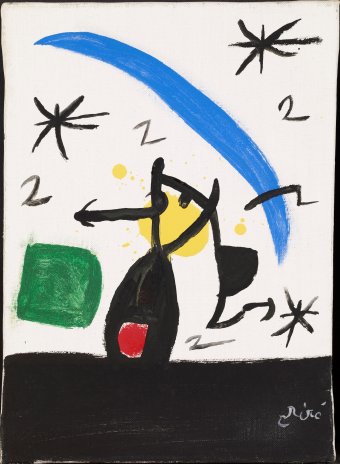
Woman and Birds in the Night, Joan Miró
When asked the classic question of my earliest memory, one stands out most vividly: at school, in art class, completely delighted by an activity where we had to recreate Joan Miró's paintings on enormous sheets of paper.
I have never been particularly drawn to surrealism and abstraction, but I like to think of this movement as a response to a period of profound cultural upheaval. In a context filled with uncertainty, discontent, and a profound existential crisis—brought about, of course, by some economic and political decisions—society embarked on both spiritual and scientific exploration. The aim? To satisfy the pressing need to distance oneself from the surrounding reality.
In the arts, this meant setting aside the techniques traditionally admired by both the public and the academy, and instead placing full emphasis on the creative process and the artist's psyche.
In 1945, the Catalan created Woman and Birds in the Night (Femme et oiseaux dans la nuit), a work in which he experimented with "childlike" and "colorful" strokes—experts' words, not mine— and formed a kind of constellation of shapes and colours that intertwine in a dynamic and spontaneous way.
I tend to see this as an art of pleasure and freedom, especially for the artist himself. It does not seek to move the viewer directly, but rather to satisfy the need for expression. It is, in a way, a case of "the end justifies the means": the work emerges from Miro's cathartic process, as those around him later confirmed—"he wanted to feel like a child again, to see the world through a child's eyes".
For this reason, it becomes an ideal vehicle for a personal process of emotional liberation: free from constraints, free from expectations, and driven by no purpose other than the pursuit of a profound sense of well-being in its creation.
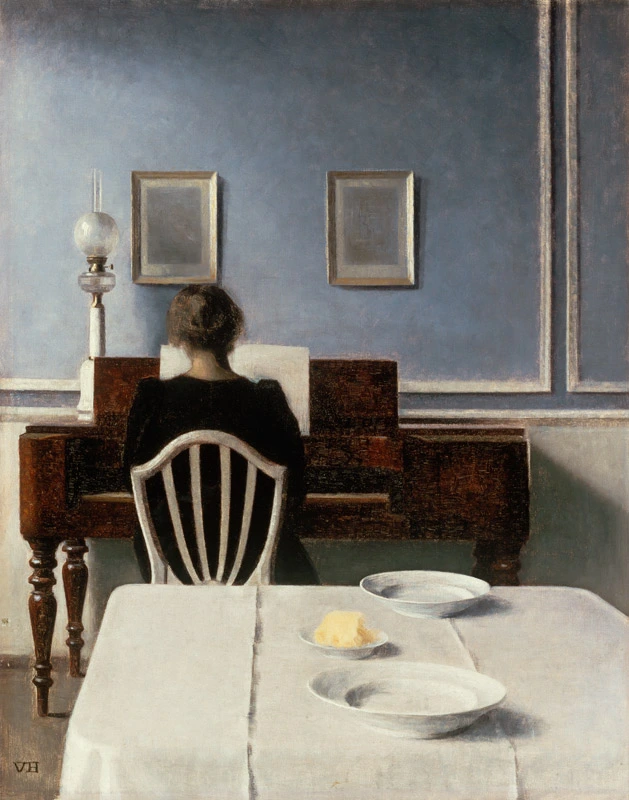
Interior with a Girl at the Piano, Vilhelm Hammershøi
If you're looking forward to seeing the work of the Danish artist Hammershøi, you should know that you're about to enter a space that is serene, austere, elegant, and subtly lit. Most importantly, it's a space where stillness is never synonymous with emptiness, but instead hums with a quiet, almost musical presence.
In my view, this artist's mastery lies in the delicate balance between the melancholy of what might have unfoldedin the space he depicts and the patient anticipation of what may be about to occur.
He never painted strangers, nor did he accept commissions from unknown sitters. He only painted those he knew well, which explains why, after his marriage to Ida Ilsted, she became his muse and the near-exclusive subject of his compositions.
It's also worth noting that—unlike many of his colleagues— this painter seems to set aside the well-established male gaze, portraying his wife with a profound and almost reverential respect. In 1901, for example, he observes her quietly as she is absorbed in her own creative process; he lets her be, lets her exist. From this emerges Interior with a Girl at the Piano: a gentle, appreciative, and curious gaze.
Three decades later, the British writer Virginia Woolf declared that what a woman truly needs is money and a room of her own. It is then that we can see ourselves—and be seen—as autonomous beings, capable of cultivating a rich and abundant inner world.
And I couldn't agree more with Woolf —or be more grateful to Hammershøi.
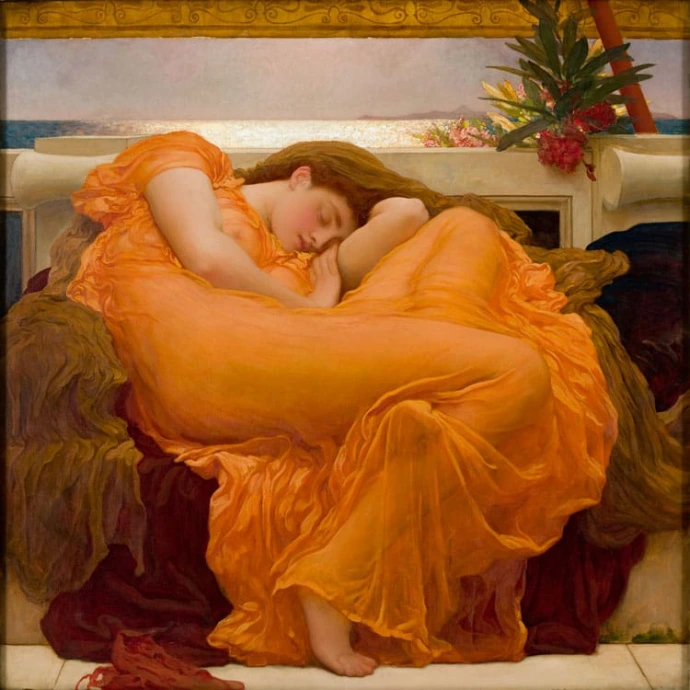
Flaming June, Frederic Leighton
I must confess, I own this book for one reason and one reason only—its cover features Flaming June by Frederic Leighton.
It's been three years since I first bought it, and I still don't know whether the novel bears any relation to the painting, as I haven't managed to get beyond page fourteen. Yet I simply can't bring myself to part with it.
This painting was created in 1895, just a year before the artist's death. Almost in keeping with the ways of the art world, it was largely overlooked at the time, purchased for very little by a businessman who either recognised its potential—or perhaps simply took pleasure in the presence of this sleeping woman. Over time, however, it has come to occupy a place of distinction and is now celebrated as one of the finest exemplars of Victorian art.
The main reason this painting captivates me—aside from, of course, my wish to one day own that radiant orange dress—is that observing this woman instantly transports me into every single myth and legend in Ovid's Metamorphoses.
It doesn't really matter which —the beauty lies in the fact that she seems to belong to them all. She could be a powerful goddess who, driven by her exalted emotions, has just destroyed, transformed, or defended a civilisation and now, exhausted, surrenders to a deep sleep; a muse at rest before answering her next invocation; a mortal punished or ensnared by some spell from Olympus; a nymph resting after being chased...the possibilities are endless.
And honestly, who could resist the allure of a compelling myth from the 1st century BC?
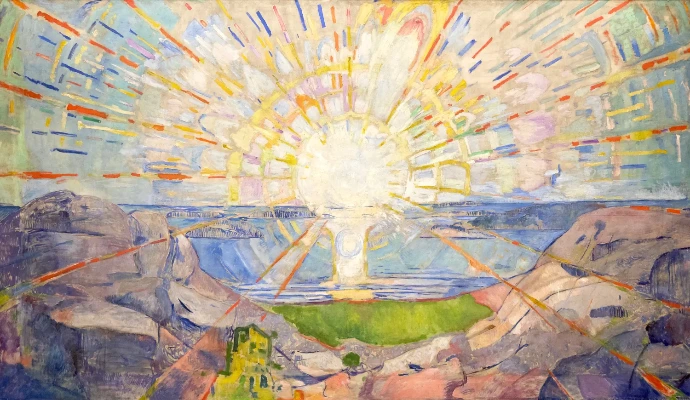
The Sun, Edvard Munch
I planned an entire trip to Norway just to see this painting in person. Spoiler alert: it was eventually cancelled, and I never did get the chance to see it.
For me, Solen is the perfect example of a painting that delivers a humbling blow. I thought I knew who Munch was, and I was naïve enough to believe I understood his visceral, melancholic, and somewhat grotesque style (completely understandable, given the life and childhood he endured). But then I see this image, and suddenly I'm left speechless.
In my defence, I must say I wasn't the only one to feel this way. When the idea arose to decorate the auditorium of the University of Oslo (where the work is housed), Munch's style was hardly at the top of everyone's list, and they weren't entirely confident about it. Just imagine, for a moment, going to university every day and be confronted with The Scream, Melancholy, The Sick Child...even the titles alone are enough to unsettle you.
Things weren't looking particularly good for our artist. But, fortunately —or unfortunately— depending on how you see it, he spent some time in the hospital, and upon leaving, he began to explore and incorporate light into his works. And thus, in 1911, The Sun was born.
I personally believe it was a brilliant choice. This image (also gigantic, by the way) radiates such energy that it leaves a profound, almost anaesthetising sense of happiness in the body. It's easy to feel those rays of sunlight enveloping you, filling every inch of yourself with a warm and comforting energy.
Here's a link so you can experience firsthand the feeling that emerges from this artist's use of light and shadow.
That being said, I can't help but wonder: will I ever make it to Norway and experience it in person?
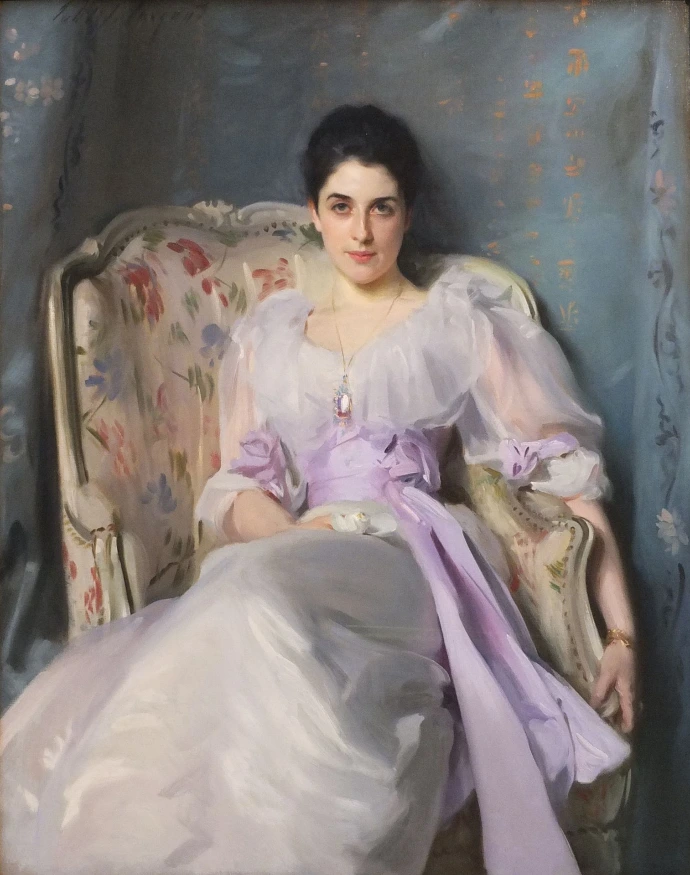
Lady Agnew of Lochnaw, John Singer Sargent
Have you read Hamnet by Maggie O'Farrell? Whenever I look at the portrait of Lady Agnew of Lochnaw, I'm immediately struck by the same mysticism and physical resemblance to Agnes (setting aside, of course, the fact that they belonged to entirely different worlds).
Some time ago, I was fortunate enough to take an art history course in Scotland, and when it came to write our final essay, I couldn't have been more certain about which artwork I wanted to focus on: I had discovered this lady in Scotland, and I knew I would write about her before returning to Spain.
Writing an essay can be somewhat tedious, given its rather rigid structure. But what was fascinating about this painting —and what I enjoyed most in studying it— was that the mysteries surrounding it made the experience feel more like telling a story or a legend than composing an academic paper.
Beyond the style and colours (exquisite, if you ask me), I'm absolutely thrilled by the fact that, in 1892, Sargent chose to paint a Scottish aristocrat in the least aristocratic way possible.
Our subject, Gertrude Vernon, has a gaze that makes you wonder who she truly is and what her daily life might have been like, beyond merely being "the wife of a wealthy man who one day decided to commission the services of a fashionable artist".
There isn't much information available, but it is said that Lady Agnew's relaxed, reclining posture was a result of the illness she was enduring at the time, which left her exhausted, fragile, and convalescent. I am certainly no one to dispute this theory in the slightest, yet what it conveys to me personally is quite the opposite: I see determination and character, not weakness.
At the end of the course, we had the privilege of visiting the Scottish National Gallery, and I can confirm that it truly is a monumental portrait — not just literally due to its size, but because, if you're lucky enough to see it in person, it can leave you rooted to the museum's red carpet for several minutes.